
Laurens County Court Records After Arrest
The arrest-to-court path in Laurens County starts with booking at Johnson Detention Center when the person is held in county custody. The jail roster can show arrest or warrant entries, statute references, charge descriptions, bond type, bond amount, and the court or authority that set bond. Those details are custody records. Formal court records after a jail arrest are maintained by the courts, the clerk, and the prosecutor as the criminal case moves forward.
The Laurens County Clerk of Court is the repository for General Sessions, Common Pleas, Family Court, and Juvenile Court documents filed at the circuit-court level. For custody and booking detail, use the Laurens County jail inmate records page. For booking photos tied to current custody, use the Laurens County jail mugshots page. Court records after an arrest answer a different question: what charges were filed, where the case is pending, and how the court has treated those charges.
Find Laurens County Court Records After Arrest
The official starting point is the South Carolina Judicial Branch Case Records Search hub. It lists Laurens County in Judicial Circuit 8 and links to the county public index. The state page warns that cookies and JavaScript must be enabled, and some browsers may require a pop-up exception to open case detail. It also notes that home address information is no longer displayed on the public index for new and existing cases beginning January 1, 2026.
- Search the Laurens jail roster first if the arrest was recent, then note the arrest date, charge wording, statute references, bond text, and any "Set By" court.
- Open the South Carolina Judicial Branch case-records hub and select Laurens County.
- Search by defendant name. Use case number when it appears on court paperwork, bond paperwork, or a docket notice.
- Narrow by court type, court agency, or filing date when many similar names appear.
- Read each charge, docket entry, hearing date, disposition, and bond entry in the case record before treating the result as complete.
The public index may lag the jail roster, especially soon after booking. If the online index does not show a case, the next step depends on the stage: Bond Court or Magistrate Court for early bond and preliminary matters, the Clerk of Court for filed circuit-court documents, and the Solicitor's Office for prosecution records subject to its own rules.
The South Carolina Judicial Branch Laurens County courthouse page lists courthouse, clerk, magistrate, and bond-court contacts.
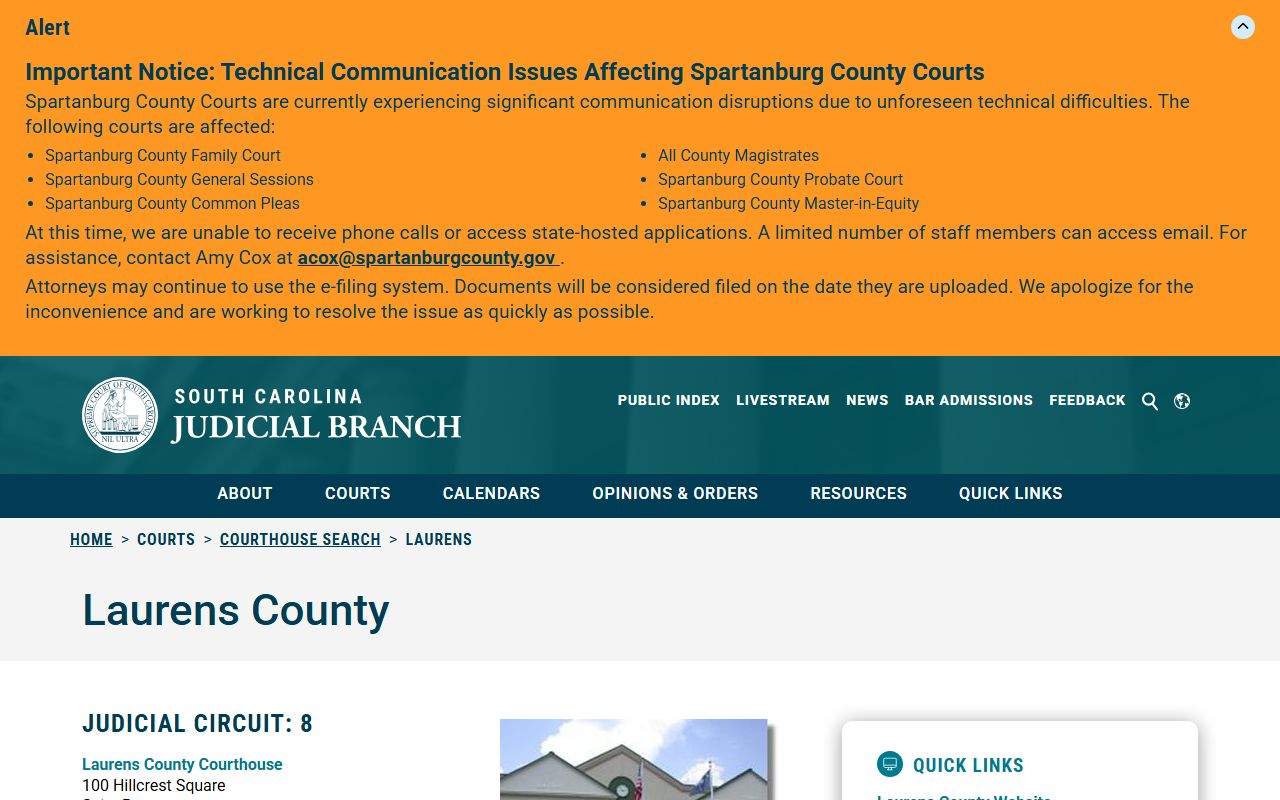
That courthouse listing is useful because it separates the Clerk of Court and courthouse from Bond Court at the jail address.
Laurens Court Record Search Fields
The state public index has several search paths. Case number is strongest when it is known. Name search is more common after a jail arrest, but it can return several people with similar names. Filing date and court-type filters help when the arrest date is known from the roster.
| Field or control | Type | Required | How it helps |
|---|---|---|---|
| County or Laurens link | County selection | Yes at hub level | Selects Laurens County from the state case-records hub. |
| Case Number | Text | No | Best when copied from court, warrant, or docket paperwork. |
| Last Name | Text | No | Primary defendant-party search path. |
| First Name | Text | No | Narrows common surnames. |
| Middle Name | Text | No | Helps separate similar names. |
| Court Agency or Court Type | Dropdown or control | No | Can narrow circuit, magistrate, or other court levels when available. |
| Date Filed range | Date range | No | Useful when the likely filing period follows a known arrest date. |
Charges Filed After an Arrest
South Carolina prosecutors are called solicitors, not district attorneys. Laurens County is in the Eighth Judicial Circuit, which also covers Abbeville, Greenwood, and Newberry counties. The Eighth Judicial Circuit Solicitor reviews and prosecutes many state criminal charges after arrest. A roster charge can change once the solicitor reviews evidence, files a formal charge, amends a charge, diverts the case, dismisses it, or presents it for indictment.
| Document type | Who is involved | What it means |
|---|---|---|
| Complaint | Law enforcement, court, or prosecutor depending on stage | Often starts lower-court or early criminal process after an arrest or warrant. |
| Information | Prosecutor | A formal prosecutor-filed charge document when allowed by procedure. |
| Indictment | Grand jury and Solicitor | A formal accusation used in serious General Sessions cases. |
The Eighth Circuit Solicitor Laurens office is listed at 100 Hillcrest Square, Suite N, with phone 864-984-2202. The solicitor does not run the jail roster, but that office is central once jail charges become a court prosecution.
Laurens Charge Status Terms
A jail arrest can produce several status changes. The roster may show the arrest basis and bond status while the court case later shows filings, hearings, pleas, dismissals, or other outcomes. Treat a booking charge as an allegation unless the court record shows a conviction or other final disposition.
| Status | What it means |
|---|---|
| Pending | The charge is open and no final court outcome has been entered. |
| Amended or reduced | The charge changed after review, negotiation, evidence review, or court action. |
| Dismissed | The court or prosecutor ended that charge without a conviction on that count. |
| Nolle prosequi | The solicitor formally chose not to proceed on that charge. |
| Convicted | A guilty plea, verdict, or other adjudication created a conviction record. |
Bond Court After Laurens Arrest
Bond is often visible before the full court case is easy to find. Inspected Laurens roster entries showed bond text such as CASH, CASH OR SURETY, and NO BOND, with dollar amounts where applicable and a "Set By" label that can point to a municipal court, family court, or other authority. The South Carolina Judicial Branch lists Laurens County Bond Court at 154 Templeton Road, the same address as Johnson Detention Center, with office phone 864-683-4485.
| Bond type | How it works in records |
|---|---|
| Cash bond | A money bond must be paid as directed by the court or jail. Laurens official pages did not publish a full bond-payment method list. |
| Surety bond | A bondsman or surety may post the bond if the bond order allows it. |
| Cash or surety | Observed roster language meaning either route may satisfy that bond if no other hold blocks release. |
| Personal recognizance | Release based on a promise to appear when granted by a court. |
| No bond | The person cannot be released on that hold by paying money unless a court changes the status. |
Warrants and Laurens Court Records
The same Zuercher/CentralSquare portal system includes a warrants module at the Laurens warrants portal. The sheriff site did not expose a separate traditional warrant-list page during research, so the portal should be checked live before relying on it. Warrant search fields in the public template include name, race, sex, date issued, DOB or age range, bond amount, and charge.
A warrant can become part of the court-records-after-arrest path when it leads to booking. The jail roster may show WARRANT in the hold reasons, while the court record may show the case, bench warrant, failure-to-appear entry, or later disposition. Routine warrant confirmation should use sheriff or court contacts, not 911. A person who believes they have an active warrant should consider legal counsel before appearing in person because arrest may follow.
Charges vs Convictions
Charges and convictions are not the same thing. A Laurens County arrest record or jail roster entry can show allegations, hold reasons, and bond terms. A conviction exists only after a guilty plea, verdict, or other court adjudication. Use court disposition fields, not roster wording alone, to describe final outcomes.
| Charge | Conviction | |
|---|---|---|
| Stage | Allegation or formal accusation | Final court outcome after plea, verdict, or adjudication |
| Where seen | Jail roster, warrant, complaint, public index, or indictment | Court disposition, plea, sentence, or judgment entry |
| May change | Yes, charges may be amended, reduced, added, or dismissed | Can change only through later legal action, appeal, post-conviction relief, or expungement where allowed |
Sealed and Expunged Arrest Records
South Carolina expungement law, including S.C. Code Ann. Section 17-22-910 et seq., controls when qualifying arrest and charge records may be removed from public access. Not every dismissal, old case, or unwanted search result qualifies. Juvenile records are also governed by separate confidentiality rules under Title 63, Chapter 19.
| Sealed | Expunged | |
|---|---|---|
| Public visibility | Hidden from ordinary public view when a court or law limits access | Removed under a qualifying expungement order or statute |
| Who controls it | Court rules, confidentiality law, or order | Expungement process through prosecutor and court channels where eligible |
| Laurens search effect | Some details may not appear in the public index | Public-facing records may be removed or restricted after the process is complete |
Background Check Limits
Public court records are not the same as a legally compliant employment, tenant, credit, or insurance screening report. The public index can help locate a case, but it may not show every restricted record, expunged matter, sealed juvenile matter, or delayed update. Official certified records should come from the responsible court or agency.
Important: Do not use casual jail, court, or locator searches for any FCRA-regulated screening decision.
Restricted Court Records After Arrest
South Carolina FOIA and court-access rules do not make every arrest-related detail public. S.C. Code Ann. Section 30-4-40 includes exemptions for law-enforcement, safety, privacy, and protected information. Juvenile records are handled differently from adult criminal records. Ongoing investigations, protected victim information, sealed records, expunged records, and some family-court material may be unavailable or limited in the public index.
The Clerk of Court, Magistrate Court, Bond Court, Sheriff's Office, county FOIA channel, and Solicitor may each control different records. A complete search after a jail arrest may need more than one contact, especially when the person was arrested recently, released quickly, or transferred from county custody before the court index updated.